Main Street Got a New Pizza Counter. Pilot Knob Got Something Bigger.
If you drove down Main Street in Mendota Heights this past Labor Day weekend, you probably noticed the new sign at 750 Main St., Suite 100. Happy Joe's Pizza & Ice Cream opened its doors on Monday, Aug. 31, the third Happy Joe's location in Minnesota and the first anywhere near the Twin Cities, joining sister locations in Crookston and New Ulm. It's locally owned and operated by franchisee Brian Smith, and it pairs the chain's taco pizza with scoops of Bridgeman's ice cream, a brand made just down the road in Woodbury.
That's the obvious news. The less obvious news is happening about two miles east, on a bluff most residents have driven past hundreds of times without ever pulling over. Pilot Knob, known to the Dakota as Oȟéyawahe, has spent nearly two decades collecting funding, partnerships, and restoration work that is finally converging into something residents can actually walk through. The new pizza counter tells you Mendota Heights is growing. The hill tells you the city is finally investing in what already made it worth living in.
Main Street's dining lineup has quietly gotten more interesting this year. Happy Joe's brings a format the neighborhood hasn't had before: made-to-order pizza, arcade games, and dedicated party space, plus underground parking that matters more than it sounds like it should once the first real cold snap hits.
A few blocks over, The Copperfield at 735 Maple St. keeps doing what it's done for years. The breakfast spot picked up Gold for Best Breakfast and Gold for Best Pancakes in the 2026 Minnesota's Best awards, part of a streak that stretches back to at least 2022. It's the kind of recognition that doesn't make headlines but tells you something reliable is still there, still good, and still worth the wait on a Saturday morning.
Together, the two spots frame a small but real shift: a neighborhood with an established breakfast anchor now also has a family-casual dinner option that didn't exist a month ago. That's a nice update. It's not the story.
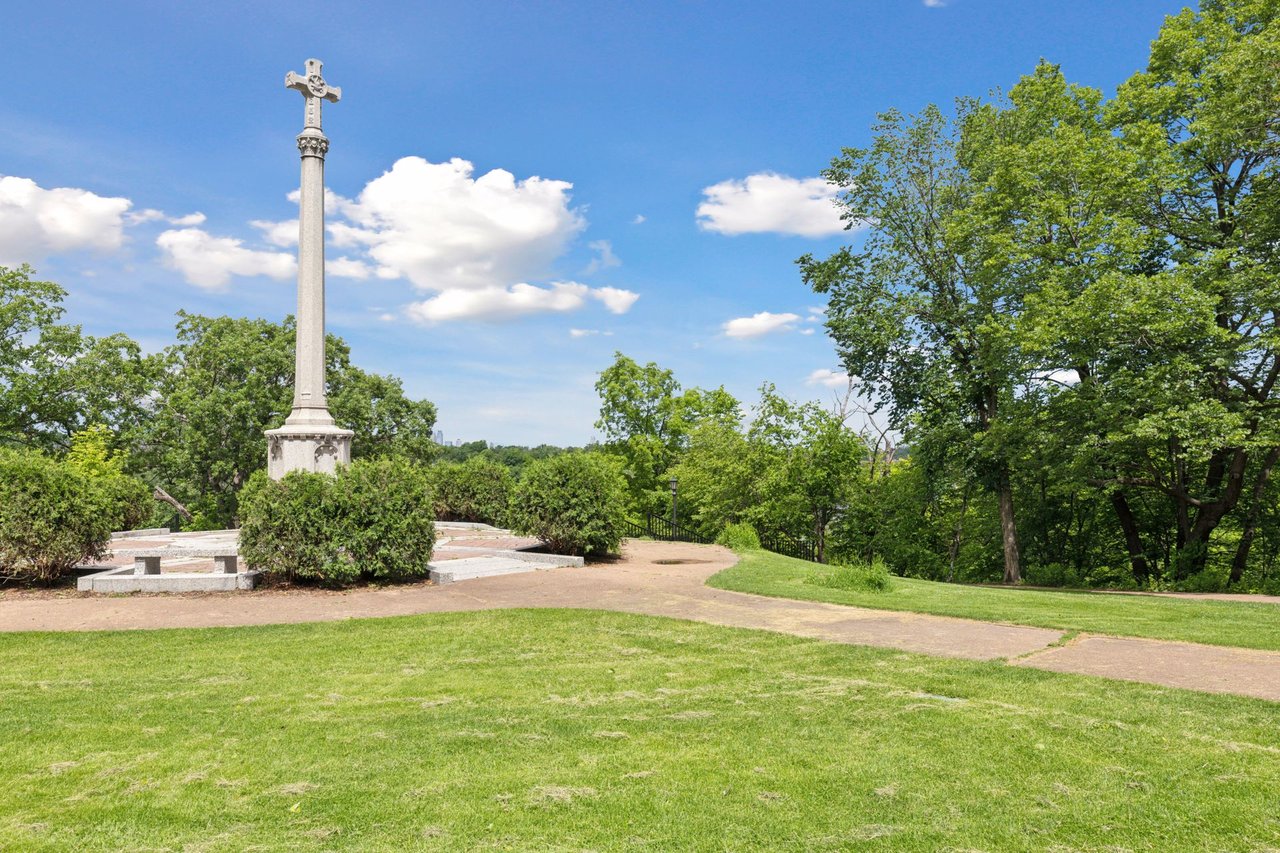
Pilot Knob Road runs north from I-494 and dead-ends at a bluff overlooking the confluence of the Minnesota and Mississippi Rivers. From the top, on a clear day, you can see Fort Snelling, the Mendota Bridge, and the skylines of both Minneapolis and St. Paul. The city of Mendota Heights describes the site, roughly 112 acres in total, as a place of both ecological and historical importance, and it earned a spot on the National Register of Historic Places in 2017.
The history is heavier than the view suggests. This is where the 1851 Treaty of Mendota was signed, the agreement that ceded millions of acres of Dakota land to the federal government. Long before that, and long after, Dakota people gathered here for ceremony and burial. In 1848, Illinois Senator Stephen Douglas even proposed the hill as the site of Minnesota's territorial capital, drawn to its views over the river valley. The capital went to St. Paul instead, but the hill kept its significance to the people who had always considered it sacred.
When the site's National Register listing was announced, a St. Cloud State University professor and citizen of the Lower Sioux Indian Community summed up what the recognition meant in a way that's stuck with a lot of people who've followed the project since:
"Dakota people still cherish this place, as we always have done."
The reason Pilot Knob looks the way it does today traces back to 2002, when a developer proposed building 157 town homes on the hill's north slope. Dakota communities, historians, environmental groups, and neighbors pushed back, and the fight led to the founding of the Pilot Knob Preservation Association. Between 2005 and 2008, a coalition that included the Trust for Public Land, the Minnesota Department of Natural Resources, Dakota County, the city of Mendota Heights, and the Preservation Association itself assembled roughly 25 acres of public land at the site.
Since 2006, the nonprofit Great River Greening has been restoring that acreage to oak savanna, the vegetation that existed before European settlement. Along the trail, a sculptural installation by artist Seitu Jones marks the Seven Council Fires overlook: carved limestone blocks arranged in a circle, each engraved with the name of one of the seven council fires of the Dakota Nation.
The next phase is the one that actually changes how people use the site. In May 2023, Governor Tim Walz approved $1.85 million in state capital investment funding for Pilot Knob, aimed squarely at making the site ADA compliant. The design plan on file calls for a new parking lot, a wheelchair-accessible looped trail, a gathering structure, updated signage, and additional artwork by a Dakota artist. None of that existed as recently as a few years ago.
Here's the part that explains the disconnect. As of the most recent trail documentation, Pilot Knob has interpretive signs and a gravel path and nothing else. No restrooms. No formal parking lot, just street parking near the top of Pilot Knob Road. Roughly a fifth of the trail is steep, unpaved, and rutted as it descends west toward Sibley Memorial Highway, where it connects to the Big Rivers Regional Trail.
That combination, sacred and scenic but structurally bare bones, explains why the site has always drawn more institutional visitors than casual ones. In a recent year, the Preservation Association logged more than 500 students and 1,200 adults visiting in organized groups, mostly school field trips built around the teacher's guide developed with the Minnesota Humanities Center. Those are people who came because a program brought them. They're not the neighbor walking the dog after dinner.
Once the ADA-compliant trail and parking lot are in place, that changes. The hill stops being a place you visit on a field trip and becomes a place you can actually loop through on a Tuesday evening, connected to the same regional trail network that already carries Mendota Heights residents on bikes and on foot every week.
The city already seems to know this. Heights Fest, the community's summer legacy event formerly known as Parks Celebration, ran Aug. 7 through 9 at Mendakota Park with a lineup built for exactly this kind of neighborhood turnout:
Folding a guided tour of Pilot Knob into the same weekend as the food trucks and the fishing derby isn't an accident. It's the city treating the hill the way it hopes residents eventually will: not as a historic marker you read about once, but as part of the regular rotation of things you do around Mendakota Park, Rogers Lake Park, and Ivy Hills Park.
A new pizza counter on Main Street is the kind of update every growing suburb gets eventually. What's harder to come by is a 175-year-old gathering site finally getting the parking lot, the accessible trail, and the funding it needed to go from a place people drive past to a place people actually walk. Mendota Heights got both this year. Only one of them required an act of the state legislature.
If you're the kind of person who likes knowing what's actually changing in the neighborhood you call home, that's the kind of texture worth paying attention to season by season. Natasha Cejudo covers Mendota Heights and the surrounding Twin Cities communities with exactly that lens. Let's connect — start the conversation.

Market Update
All in good light
Market Update
Here's what closed between September 13 and September 21, neighborhood by neighborhood.

Blog
Hispanic Heritage Month, Mexican Independence Day, and the Humanitarian Award Minneapolis Just Earned
Market Update
Macalester-Groveland, Highland Park, Summit Hill, Summit University & Merriam Park | August 31–September 8, 2026
Natasha prides herself on an honest, transparent, and comprehensive approach based on mutual understanding and clear communication. She is patient, insightful, attentive, and responsive; her professionalism, humor, and candid approach make her a joy to work with. If you are considering a move this year or next, she would welcome a conversation with you!